
Union County Court Records After Arrest
The arrest side and the court side are different records systems. Union County Jail can confirm whether someone is in custody, whether bond has been set, and whether a transfer or hold exists. The court record after a jail arrest is handled through the court file once charges are filed or a hearing is scheduled. Union County's Clerk of Superior Court page says the clerk is responsible for civil and criminal affairs and filings made in Union County Superior Court. The county courts page says Superior Court conducts hearings and trials in civil and criminal cases.
Union County is in the Enotah Judicial Circuit with Lumpkin, Towns, and White counties. The Enotah District Attorney's Office prosecutes state crimes in the circuit and is led by District Attorney Jeff Langley, according to official circuit material captured in the research. The Union County courts page lists the District Attorney Office phone as 706-864-6754. For the custody side, use Union County jail inmate records; for booking photos, use Union County jail mugshots only as a separate records issue.
Find Union County Court Records
No official Union County online criminal defendant case-search portal was located on the county court or clerk pages. That means the official court records after a jail arrest path starts with the Clerk of Superior Court rather than a public case-search screen. The clerk is Judy Odom. The office is at 65 Courthouse Street, Blairsville, GA 30512, phone 706-439-6022, Monday-Friday, 8 a.m.-5 p.m. The county open-records routing page also directs court records, property deeds, divorce decrees, plats, covenants, and restrictions to the clerk's phone number.
- Confirm the custody side with Union County Jail at (706) 439-6080 if the person may still be detained.
- Ask the jail or records office whether a case number, court date, or court name is known.
- Contact the Clerk of Superior Court at 706-439-6022 for criminal filings in Superior Court.
- Give the defendant's full legal name, date of birth if known, arrest date, and case number if available.
- Ask whether the case is pending, bound over, indicted, dismissed, resolved by plea, or otherwise disposed.
- For prosecution-stage questions, contact the Enotah District Attorney's Office at 706-864-6754.
The Clerk of Superior Court page identifies the local office that handles Union County criminal filings.
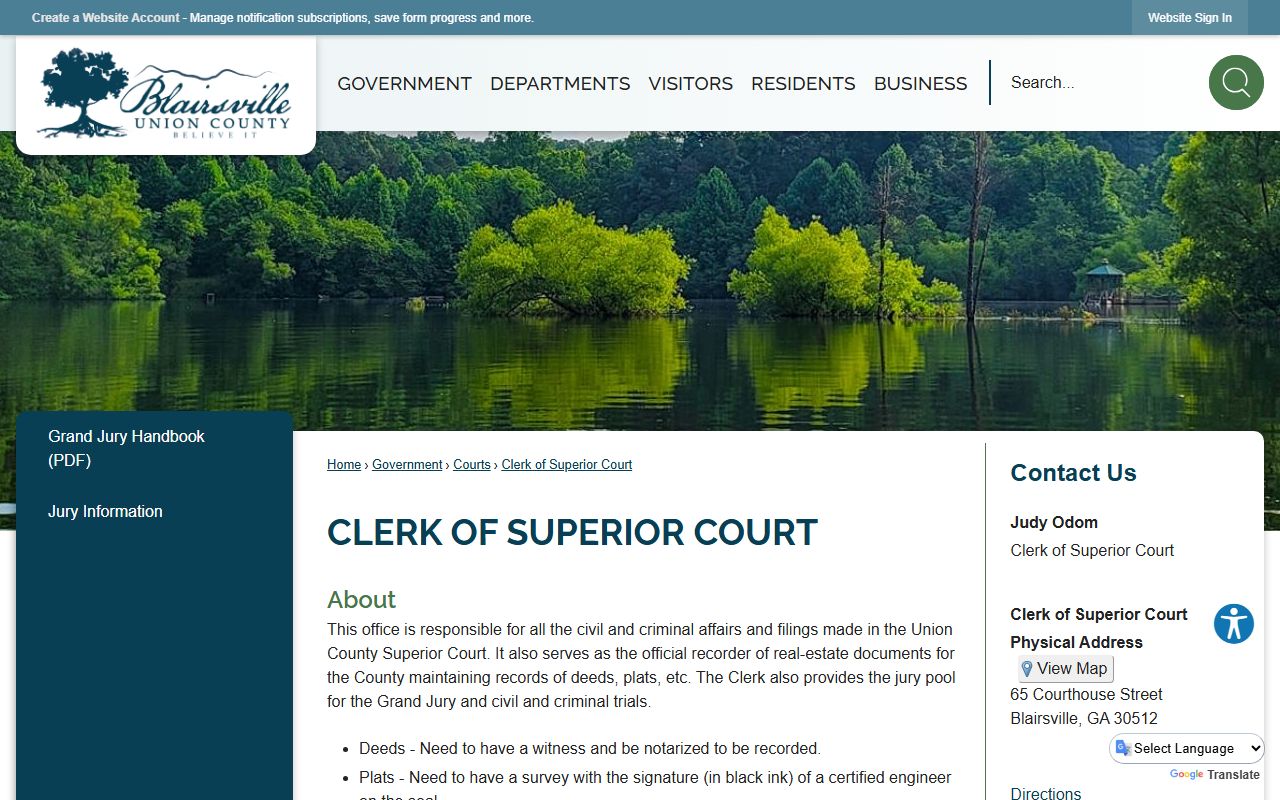
The clerk page is central because no official online criminal case-search portal was found for Union County court records after arrest.
Union County Case Search Limits
A no-portal table is the most accurate way to describe court record access for Union County. The county does publish court and clerk office information. It does not publish a visible official criminal defendant search form in the researched source set. Users should not assume that a statewide real-estate or index link on a clerk page covers jail arrest charges.
| Field Label | Type | Required | Options / Format Notes |
|---|---|---|---|
| Not located | Not located | Not located | No official Union County online criminal case-search form was located on county court or clerk pages. |
| Defendant name | Phone or in-person request | Helpful | Give full legal name and date of birth if known when contacting the clerk. |
| Case number | Phone or in-person request | Helpful | Use if the jail, court notice, attorney, or clerk has already provided it. |
| Arrest date | Request detail | Helpful | Helps connect the jail arrest to the later court filing. |
Union County Charging Documents
After a jail arrest, the first jail booking charge is not always the final court charge. An arrest may begin with officer paperwork, a warrant, or a complaint. A prosecutor can later file an accusation or information, amend a charge, reduce it, dismiss it, or seek an indictment. In Union County felony matters, the Enotah District Attorney's Office and the court process determine which charges become part of the formal court record.
| Document | Filed By | Common Use | Record Location |
|---|---|---|---|
| Warrant or complaint | Law enforcement and court process | Initial arrest and probable-cause basis. | Sheriff or court record depending on stage. |
| Accusation or information | Prosecutor | Prosecutor-filed charges in eligible Georgia cases. | Clerk and court file. |
| Indictment | Grand jury | Felony prosecution after grand-jury action. | Clerk and Superior Court file. |
Union County Charge Status
Charge status is the point where court records after a jail arrest become more useful than a booking note. A booking charge may describe the arrest basis. The court charge shows what is being prosecuted. Each count can move at a different pace. One count may be dismissed while another remains pending. A felony matter may be bound over from a lower court to a higher court before indictment or plea.
| Status | What It Means |
|---|---|
| Pending | The charge has not reached a final disposition. |
| Amended | The charge language, count, or level changed in the court record. |
| Reduced | The prosecutor or court lowered the charge or resolved it to a lesser offense. |
| Dismissed | The charge ended without a conviction on that count. |
| Nolle prosequi | The prosecutor declined to continue prosecution on the charge. |
| Bound over | A lower-court matter was sent to a higher court, often for felony handling. |
| Convicted | A guilty plea, bench verdict, or jury verdict was entered. |
| Acquitted | A not-guilty verdict was entered. |
Note: A jail booking charge is a starting point, not proof that a person was convicted of that charge.
Union County Clerk and DA
The Clerk of Superior Court is the official records contact for Union County Superior Court criminal filings. The clerk's office can identify whether a case exists, whether a case number is available, and what filing or disposition information is in the public court record. The clerk is not the jail and should not be used for release logistics. The jail handles custody. The clerk handles the case file.
The Enotah District Attorney's Office is the prosecution office for the circuit. Union County's courts page lists the DA phone as 706-864-6754, and the circuit includes Union, Towns, White, and Lumpkin counties. Prosecutor-filed charges may differ from the original jail booking charges. DA filing decisions can include adding counts, reducing counts, dismissing counts, or presenting a felony case for indictment. For defense advice, a defendant should speak with counsel, not the jail or clerk.
The Union County courts page identifies the Enotah Judicial Circuit and the local DA phone used for court records after arrest routing.
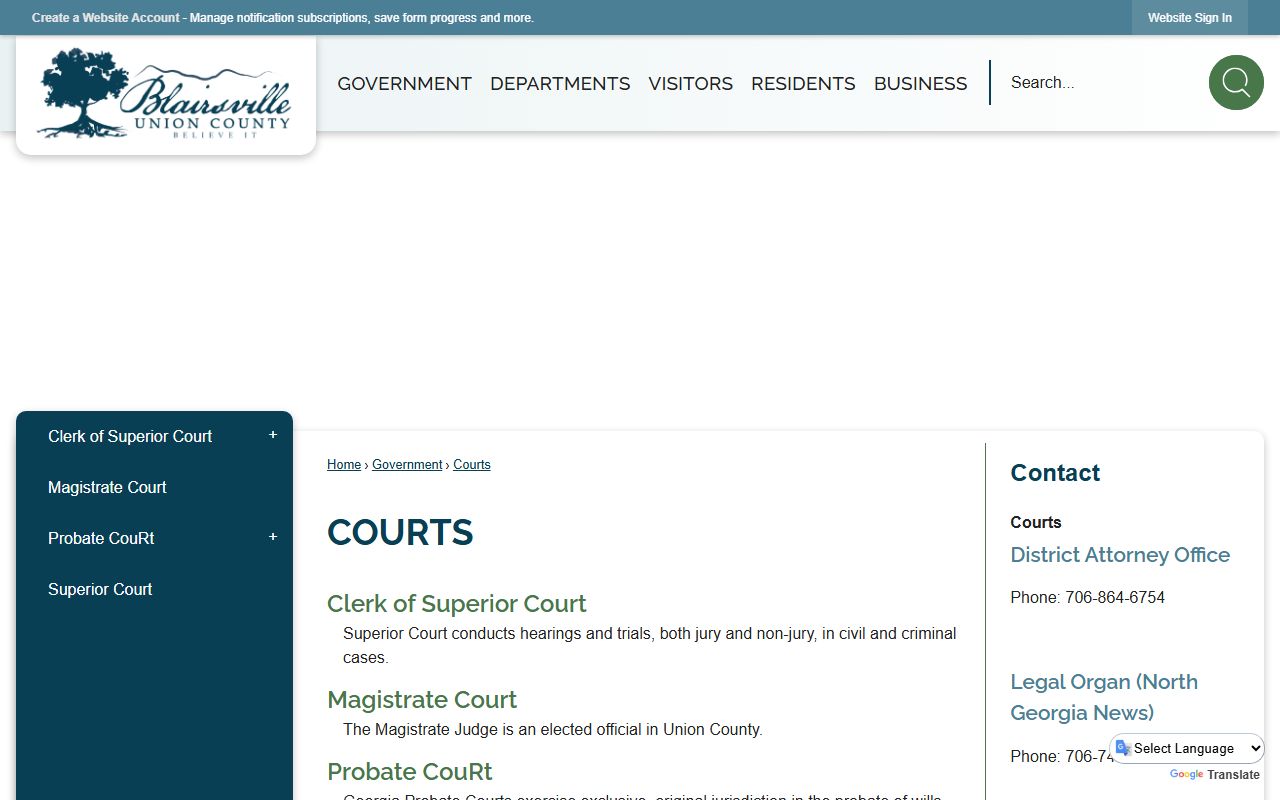
The courts page helps place Union County arrest cases inside the broader Enotah Judicial Circuit.
Bond After Union County Arrest
Bond is a custody issue and a court issue. The jail may know whether bond has been set and whether a person can be released. The court decides many bond terms, and another agency hold can block release even if local bond is posted. The sheriff jail page mentions a bonding window in the context of money orders, but the official pages reviewed do not publish a detailed bond schedule or a list of accepted bond payment methods for Union County.
Call the jail before travel to confirm custody, bond amount if any, accepted payment methods, required ID, and whether another hold exists. The Warrant/Civil Division places and releases holds with Georgia DOC and arranges extraditions, so a GDC hold, out-of-county warrant, federal hold, or other detainer can change release. A detainer is a notice or hold from another agency asking the jail to keep or transfer a person after the local issue is addressed.
Warrants Before Court Records
The Union County Sheriff's Office Warrant/Civil Division page does not provide a searchable active warrant database. It does state that the division processes, serves, and maintains all local warrants, assists other counties with serving warrants, places and releases holds with GDC, and arranges felony and misdemeanor extraditions. A warrant arrest can create a jail booking first, then court records after the arrest once the issuing court or prosecutor acts.
Do not treat a most-wanted listing or warrant question as a conviction. The sheriff's most-wanted page includes a presumption-of-innocence notice and gives the sheriff contact number plus an anonymous Criminal Investigations Division tip line. For court status after a warrant arrest, use the issuing court or Clerk of Superior Court. For custody, call the jail.
Charges and Convictions
An arrest charge, a court charge, and a conviction are not the same thing. An arrest charge is the basis for taking or holding a person in jail. A court charge is the formal allegation placed in a court record. A conviction exists only when guilt is established by plea, judge, or jury. This distinction is critical in Union County court records after a jail arrest because public searches can show accusations before a case is resolved.
| Point of Comparison | Charge | Conviction |
|---|---|---|
| Stage | Accusation or formal allegation. | Final guilty plea or verdict. |
| Proof level | May start with probable cause or prosecutor filing. | Requires guilt by plea or proof beyond reasonable doubt. |
| Record effect | May be pending, amended, reduced, dismissed, or restricted if eligible. | May affect sentence, supervision, criminal history, and future eligibility. |
Restricted Court Records
Georgia often uses the term record restriction rather than expungement. Georgia Courts record restriction guidance points to O.C.G.A. 35-3-37 and explains that some eligible criminal history records can be restricted from public access. Approved pre-July 1, 2013 requests may be sent to GCIC with a $25 fee, according to the Georgia Courts page. The statute also matters for fingerprints or photographs taken with an arrest.
| Point of Comparison | Restricted or Sealed | Expunged |
|---|---|---|
| Georgia usage | Georgia's public guidance commonly uses record restriction for eligible criminal history access limits. | Often used informally, but Georgia does not always mean record destruction. |
| Public access | Eligible records may be limited from public view when approved. | Do not assume a record is destroyed unless the controlling order says so. |
| Where to start | Review the court disposition and Georgia Courts guidance under O.C.G.A. 35-3-37. | Ask the court or counsel what legal remedy applies to the specific case. |
Union County Background Checks
The sheriff admin/records page says state background checks are processed through the records office after a criminal history release form is filled out and signed. The fee is $15. That is different from a casual court records after arrest lookup and different from a consumer background report. For official statewide criminal history needs, use the authorized Georgia criminal-history process. For a court case, use the clerk and the court file.
Important: Court records after arrest must not be used for FCRA-covered screening unless a lawful consumer-reporting process applies.
Limited Union County Court Records
Georgia open-records law allows public access to many agency records, but exemptions still matter. O.C.G.A. 50-18-72 covers exemptions from required disclosure, including categories that can affect law-enforcement, prosecution, privacy, juvenile, medical, sealed, or otherwise protected records. A pending investigation may be treated differently from a closed court filing. Juvenile matters and sealed or restricted cases may not be available through the same public route as an ordinary adult criminal case.